Frequently Asked Questions about Biblical Eating

Image is a white tablecloth spread with white plates of berry muffins, and granola with strawberries, and a latte. Text overlay reads: Frequently Asked Questions about Biblical Eating | Land of Honey


Here are some of the most common frequently asked questions about Biblical eating. That means abiding by Scripture's instructions about what animals we are forbidden to eat, even as we believe in Jesus and the New Testament. We delve into lots of New Testament verses and clarify what they mean. 

Acts 10 and Biblically clean eating Q+A - Peter's kill and eat vision from a Hebraic perspective | Land of Honey


What about Acts 10:9-16? People use this to say all food is clean.

This is passage is Peter's vision of the forbidden animals being lowered on a sheet from Heaven. He hears a voice say, "Kill and eat." Many people assume the message of this vision was its face value - but Acts 11 goes on to explain what this vision meant! It's not talking about food at all. According to the Bible, the point of this vision was that no people are unclean or unfit to be part of God's family.

Does the Bible say we need to separate meat and dairy? Clean eating questions and answers. | Land of Honey

The dairy and meat separation. It's very confusing to me.

This is confusing because humans have made it that way.

The idea of separating all meat and dairy products comes from Exodus 23:19 which says not to boil a goat in the milk of its mother. It's noteworthy that the Hebrew word used means baby goat and not all cattle or animals. Many scholars believe this is about not mixing meat with that animal's specific mother's milk (as opposed to mixing goat meat with the milk of any other goat or butter made from a cow, etc), which apparently was a pagan practice in Bible times.

Since chicken, etc. are not dairy animals there is no express Biblical prohibition from mixing that with cheese, butter, etc. The text also does not seem to be talking about beef or lamb.

We should also note that we do see milk and meat served together in Scripture. Abraham served meat with milk and curds in Genesis 18:18. Many would say that the instructions on how to eat weren't given until later, so therefore Abraham just didn't know not to do this. However we see in Genesis 7 that Noah knew the difference between clean and unclean animals before then.

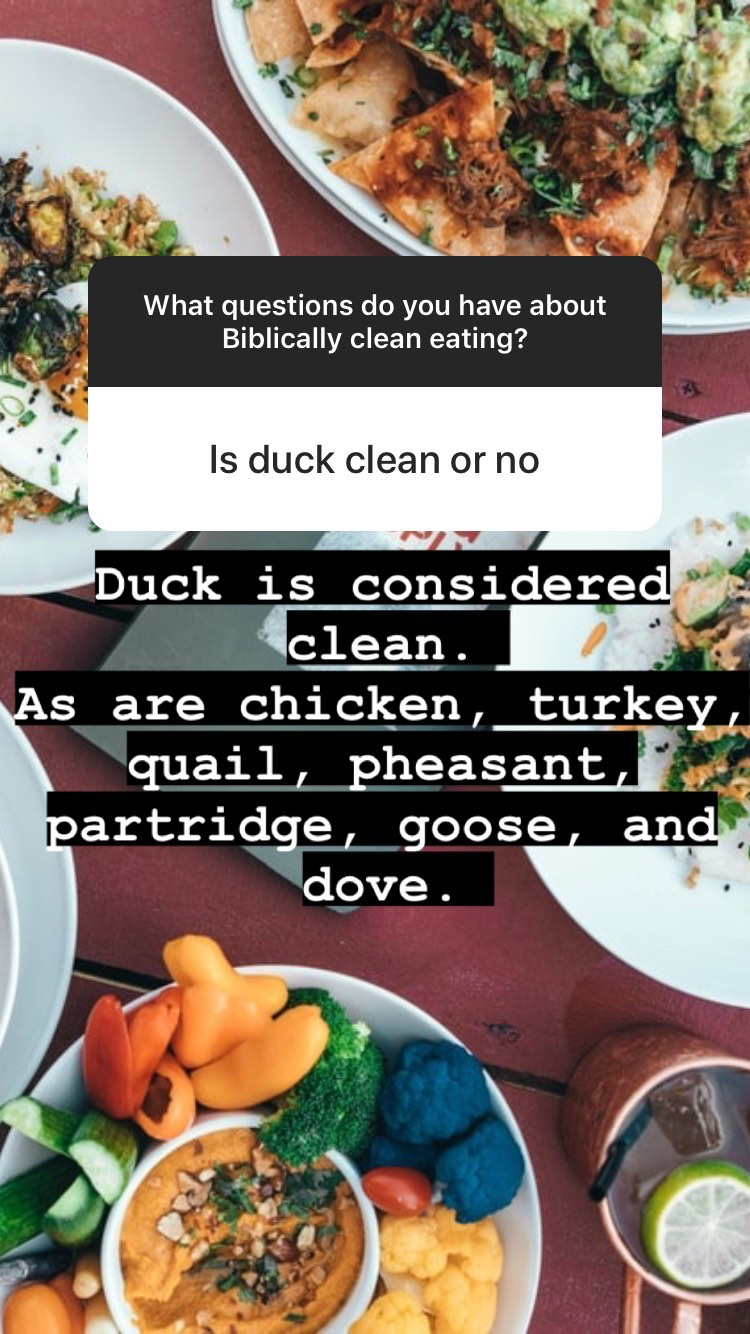
Biblically clean poultry and ducks + questions and answers about what the Bible says about food | Land of Honey


This Is duck clean or no?

Duck is considered clean. As are chicken, turkey, quail, pheasant, partridge, goose, and dove.

How do you even begin? Especially when your husband refuses?

If your spouse isn't on board then do what YOU can. If you are cooking, make clean meals and if he wants to add something unclean that's his choice.

If you're not sure what all is and isn't permitted, start avoiding what you know is off limits - bacon for example. Start to choose other options instead of bacon and then as you learn more, do more! And remember it will get easier with time!

I will link at the end of a post for a step by step guide to switching to a Biblical diet.

Is meat at stores like Walmart unclean because of slaughter methods?

Leviticus 17:13 tells us not to eat meat hat has blood in it. This can be an issue with red meat - conventional slaughterhouses do not always make it a point to drain the blood, or might not kill the animal in a way that is conducive to that.

People handle this differently - some cook the meat thoroughly, others salt meat to draw out the blood, others buy only meat where they know how it was slaughtered, and some only feel comfortable with certified kosher meat.

I find it difficult to find kosher certified meat, any suggestions?

Talk to small scale butchers near you and find out their slaughtering practices. Many are consistent with kosher methods, but without the certification.

Call the nearest synagogue and ask if/where their congregants get kosher certified meat.

Small grocery stores can usually special order kosher meat. It helps if you place a fairly large order to make it worth their trouble.

Take a cooler and stock up when you go to a large city. You can freeze meat at home to use in the coming months. Kroger and Trader Joe's are usually good bets. Call ahead to double check that they carry it!

Kosher certified meat is rarely pastured/grass fed/local/organic, what do we ask our local farmers?

Most farmers don't do their own slaughtering. Ask if they know what that consists of. If they don't, find out where their animals are processed and contact them.

I would ask what steps they take to drain the blood, and go from there. 
There is really not much in Scripture about how an animal should be killed. Some believe that a cow's throat should be slit and drained that way. The more common method today is to first stun-gun cows in the head before slitting their throats to drain the blood. Many feel this is more humane for the animal.

Does eating Biblically mean I have to become a vegan or have a plant based diet?

No. Becoming a vegan is an option but is not something that is required to have a Biblical diet.
In Daniel we see that he switched to a plant based diet in order to avoid unclean meats that likely were sacrificed to idols. If your choice is to eat a vegan meal or unclean meat, then that's an easy decision to make to keep the Bible's commandments. In general though, you have the option to eat Biblically-sanctioned meats and dairy, if you like.

I would remind everyone that vegan eating is a personal choice and not a Biblical commandment.

What about Romans 14 where it says believers with sensitive conscience's will eat only vegetables?

This passage is mostly talking about fasting. Some people feel called to fast certain days, while others did not. Both sides should treat the other with kindness.

Are mushrooms clean?

Most people say yes because Scripture does not mention anything about them being unclean. Judaism accepts edible mushrooms as kosher. 

Others would say no since they are not a plant that produces seeds (see Genesis 1:29). Seaweed also doesn't produce seeds, so that's something to watch out for if you land on this side.

Answering questions about what we eat from Scripture's perspective | Land of Honey


What are things to avoid that might get missed?

Checking produce for bugs is always a good idea. You don't need to spend forever on it, but it's something to watch out for as you're chopping. If you find bugs you can take them off and still use the veggie or fruit.

Some beef or turkey products will have pork casings. Double check the ingredient label when you're buying any type of sausage product.

Gelatin is usually made from pork. It shows up in gelatin desserts like jello, marshmallows, pudding mixes, and lesser quality yogurt and sour cream.

You can get beef gelatin, if you are so inclined, to use in any recipes calling for it!

What kind of fish does the Bible say we can eat? | Land of Honey


What kind of fish are okay to eat?

Fish need to have fins and scales. Common fish that are Biblically clean include salmon, tuna, cod, trout, perch, sea bass, herring, pollock, tilapia, mahi-mahi, and flounder. 


Cookbook recommendations?

Pretty Simple Cooking from A Couple Cooks is a gem! It's vegetarian but they include some recommendations for incorporating meat if you'd like to. The book is also arranged by the amount of time each recipe takes, which I love! It has practical recipes for real Biblically clean meals!

A Hebraic Perspective on Mark 7 and the Messiah making all foods clean | Land of Honey


What's your interpretation of the verse in Mark 7 where it says he made all foods clean?

Mark 7 isn't talking about what is being eaten, it's talking about eating without going through a (non Bible based) ritual of hand washing. That's why they asked, "Why do your followers eat with unwashed hands?" and not, "Why are your followers eating forbidden things?"

Also, the Bible never calls unclean animals "food." When the Bible talks about "food" it means only the things that God says we can eat.

Advice on eating out for those who eat Biblically clean | Land of Honey


What are thoughts on eating out, specifically at a restaurant that serves unclean and clean food?

I feel most comfortable at restaurants that don't serve unclean meat, or at least very little of it. That said, quality restaurants (especially those accommodating to vegetarians and those with food allergies), have no problem avoiding cross contamination if asked. Restaurants like these typically have a vegetarian deep fryer and spot on the grill. If you are having meat you can request they clean the grill.


A reader mentioned watching out for restaurants that cook with lard. This is mostly a problem at southern type and Mexican restaurants, so that's something you can ask about. Again, for places that are vegetarian-friendly, this usually isn't an issue.
And if a restaurant can't tell you the ingredients they use - I would really think twice about eating there. I've worked in restaurants and there is absolutely no mystery to anyone in the kitchen about what is being used. If a waiter or waitress can't answer your questions they can always go and check with the kitchen.

Biblically Clean Eating Questions and Answers - learn more about what Scripture says about food | Land of Honey


I applaud all of you making the choice to implement a Biblically clean diet into your life! There are many things that can be debated, but wherever you land on these things I'm proud of the changes you are making! YHWH is honored by your effort to be obedient to Scripture!

More about clean eating:

All Things Work Together for Good: Grief, Pain, and Romans 8:28


All Things Work Together for Good: What We Can Learn from Suffering Fruit Trees | Land of Honey

All things work together for good. -Romans 8:28 

I was listening to a podcast with an Italian olive grower and the host asked this question that you could tell the grower thought was incredibly stupid. They had been talking about famously cold winters in years past that had damaged and killed many of his trees, the host asked if it was sustainable to keep growing olives on the outer limits of their temperature capacity. Wouldn't it be better for the olives to be in a warmer climate so they would never be damaged by the cold? Wouldn't it be better if nothing bad ever happened to the trees?

His answer was something like, "Of course it's hard on the trees. They are pushed to their absolute limits because as a gardener, I know they do better if they suffer. Suffering yields good fruit."

That really took me by surprise for a second, but of course it's true. In gardening it's important for plants to suffer or be uncomfortable or to be pruned so that they can be at their absolute best. Being stretched and pushed beyond their limits of comfort is what yields good fruit. Having a winter that is so cold that some branches and trees are lost, means more and better olives down the road. Maybe you won't see that return the very next year, or even for several years, but eventually there is no denying that the fruit is tastier and more abundant.

Are you thinking of John 15? That's where the Messiah told us that we are vines, and his Father is the gardener who prunes good branches so that they bear even more fruit, and he takes away the unfruitful parts. YHWH uses the natural to show us how things work spiritually. And in the natural, those uncomfortable, even painful, challenges are what bring forth the best fruit.

Have there been any suffering or trying circumstances in your life lately? Have you lost a loved one? Were you laid off from your job? Are you facing health challenges or strained relationships? Do you deal with anxiety or have you been stressed out by current events? While I am sincerely sorry for any pain you are in, the good news is that this will yield more fruit if we let it.

Now please hear me: I don't believe that YHWH is sitting up in Heaven passing out disease or starvation or death or abuse because that's what he wants. We live in a broken world and many things happen that are not his desire or best. He doesn't say that bad things won't happen to us but he does promise to use them for our good. And this suffering brings fruit.

As a gardener myself I cannot wish hardship on my plants. It is painful to me to see them suffering from the weather, animal encroachment, a fungus or whatnot. Ironically I spend a fair amount of time in the summer worrying if my tomato plants have enough water - when I know a bit of a drought will force them to take root. They will produce sweeter and tastier tomatoes if they lack water for a time. The plant will be stronger and more resistant to storms and disease. Because that physical challenge and discomfort yields fruit.

How many times have I as a plant or vine wished for a whole lot less suffering? Can you see me? I need water. Get these bugs off. It's too cold here! Doesn't the gardener care? I long for those temperate climates where I am comfortable all the time. I don't want to have to wonder when my provision will show up. 

YHWH is a gardener who wants good fruit. And he is skilled, and knows how to bring that out in us. What if we stopped looking at that verse in Romans like "All things work together for good in spite of the hard times," and more like, "All things work together for good, even because of the hard things"? I can't say that I am excited for pain and trials and the frustrations of life, but I am thankful that when those times come they will be an opportunity for growth and producing the very best kinds of fruit. What if we looked at those places of pain in our lives as the starting point for his amazing healing work in us? What if we were able to use the injustices we have experienced to help someone going through something similar? When we are pushed beyond our limits by life, let that bring out the very best fruits in us. 

So if you are like those olive trees who are hurting from the cold, know that you can survive this and even come out better for it. If you are in a painful season of pruning, know that your branches will become stronger for it. If you are recovering from a cold-snap or lack of water know that eventually you will produce fruit again. All these things will work together for your good.

"For this slight momentary pressure is working for us a far more exceeding and everlasting weight of esteem." -2 Corinthians 4:17

These slight momentary pressures are working for us. - 2 Corinthians 4:17 - encouraging Bible verses | Land of Honey

More:

Biblically Clean Meal Ideas


Are you new to Biblically clean eating and not really sure what meals should look like? Or maybe you've been doing this for a while and feel like you're stuck in a recipe rut? Find inspiration here! I'm sharing recipes for Biblically clean meals today. Most of these include meat or fish - because many of you have shared that you have a meat-and-potatoes family and I wanted to show that it's possible to Biblically clean and still consume plenty of meat if you wish. If you're looking for more vegetarian recipes see this post.


Please know that all of the recipes I share here, whether for the Sabbath or Passover or whatever else are of course Biblically clean and can be enjoyed whenever you like!

Related posts:
How To Eat Biblically Clean - this post is a practical guide to changing your diet.

Sharing Your Faith When Someone Wishes You Merry Christmas

When you don't celebrate Christmas it can be more than a little awkward to get "Merry Christmas" wishes multiple times a day. How can we best handle these sentiments? What are ways we can speak truth in a brief exchange at the checkout counter? How can we share our faith with coworkers and neighbors without jumping on the soapbox and having their defenses go up?

Many of you asked how I respond when someone says this to me. This is certainly not an exhaustive list of ideas, just a few things I find myself repeating at this time of year. Remind yourself that if someone wishes you a merry Christmas, or asks about your plans for the holiday, they probably sincerely mean well. You can respond with kindness without reverting to their words or even a "you too!" as you slip out the door. 

Simple phrases to respond with:

"Have a good day/weekend/vacation!" 

"Thank you for your kind wishes."

"I hope you have a nice time with your family."

"That's so kind of you to say! I actually don't celebrate Christmas but I appreciate the thought."

"I haven't celebrated Christmas for a few years now, so I don't really have any plans for the day. It's nice to not have the stress of shopping for gifts!"

"We decided to start celebrating the Biblical holidays in place of the cultural, so we haven't participated in Christmas activities for several years."

"I have felt God calling me to step back from the manmade holiday of Christmas. It's been an interesting journey and I'd love to tell you more about it sometime if you're interested."

"I don't celebrate Christmas anymore. I used to and totally get why you do. It's been quite a change but I feel like my faith has really grown because of it."

Of course, these are just ideas and phrases I use and you can customize them to fit your circumstances. It's not uncommon for me to use a couple at a time either. Usually I try to keep the tone of the conversation pretty upbeat. That's one reason I like to mention something that I enjoy about not celebrating Christmas - that my faith has grown or that I'm free from the stress of the holiday season. 

I'd also encourage you to be honest and real with whoever you're talking to. Admitting that stepping away from Christmas was difficult can go a long way with the people who put their tree up in October and don't take it down until February. Hearing that you had conviction - and acted on that past the point of convenience and comfort - definitely gives the people in your life something to think about. It's nice to have a little more time to talk when you delve into this perspective, but that said you can certainly quickly convey the idea of "It has been hard, but it's really been worth it!"

Sharing sentiments like these is an invitation for the hearer to evaluate their own actions, and the concept of Christmas in general. Many people truly do not realize that Christmas is not a Biblical holiday, and won't unless someone can give them a gentle nudge. Remember that it's not your job to explain all the details or to convince someone that Christmas isn't YHWH's best for them. It's our job to plant seeds, and sharing our faith like this is one way we can do that.


More on Christmas:
Five Things Every Believer Should Know About Christmas
Quitting Christmas
The Christmas Question
The Hebrew's Guide to Getting Through December

Upcoming Biblical Holiday Dates 2026

Here's When the Biblical Holidays Happen in 2026

This is when the Biblical holidays happen in 2026. If you're looking for this year's dates for Passover, Unleavened Bread, First Fru...