Biblically Clean Sheet Pan Meals

Biblically Clean Sheet Pan Meals - easy, real food recipes | Land of Honey


In The No-Stress Guide to Sabbath Meal Prep, I mention how sheet pan meals are great to make right before the Sabbath, but really I love these for anytime you don't have much attention or time to put into making dinner, but still want a healthy and delicious meal. Simply place all your ingredients onto a baking sheet and let it roast in the oven! The cleanup is minimal, and your hands and attention are free for other things during the cooking. These recipes are simple, easily adaptable, and made from whole, real ingredients. 

A few pointers for easy sheet pan meals:

-Don't hesitate to use an extra sheet if the recipe makes more than you expected, or you just want a double batch for leftovers.

-Instead of just using chicken breast or thighs, feel free to swap in a whole quartered/chopped chicken. This can save money or be easier for those who eat locally.

-Bake some rice. If you're looking to round out your meal, put some rice in the oven to bake while you're at it. Here's a recipe for making brown rice in the oven. Personally, I don't bother bringing the water to a boil and I just use a pan with a glass lid instead of foil. It takes a bit longer but turns out well for me.

Roasted Harissa Chicken and Potatoes from This Healthy Table

Harissa Chicken and Potatoes - easy sheet pan dinner that is Biblically clean | Land of Honey


Sheet Pan Gnocchi with Roasted Vegetables from How Sweet Eats

Super easy Biblically clean dinner - sheet pan gnocchi with roasted vegetables | Land of Honey


Garlic Ginger Chicken with Broccoli from Pinch of Yum

Garlic Ginger Chicken with Broccoli - easy Biblically clean sheet pan dinner | Land of Honey


Curried Sweet Potato Chickpeas from Minimalist Baker

Curried Sweet Potato Bowls and other Biblically clean sheet pan dinner recipes | Land of Honey


Greek Sheet Pan Chicken Souvlaki from Half Baked Harvest

Greek Chicken Souvlaki - healthy and easy sheet pan recipes that are Biblically clean | Land of Honey


Salmon and Asparagus from A Couple Cooks

Salmon and Asparagus + Biblically Clean Sheet Pan Dinner Recipe Round Up | Land of Honey


Kung Pao Cauliflower from How Sweet Eats

Biblically Clean Sheet Pan Meal Recipes - Kung Pao Cauliflower + other healthy dinner ideas | Land of Honey


15 Minute Kale and Egg Bake from Healthy Nibbles

Sheet Pan Meal - Kale and Egg Bake - easy Biblically clean breakfast recipe | Land of Honey


Nacho Chicken from How Sweet Eats

Healthy Nacho Chicken Sheet Pan Recipe + other Biblically clean meal ideas | Land of Honey


Sheet Pan Sweet Potato Tacos from A Couple Cooks

Sheet Pan Sweet Potato Tacos - Biblically clean recipe round up | Land of Honey


Mediterranean Salmon from This Healthy Table

Mediterranean Salmon Recipe - Biblically clean sheet pan meals | Land of Honey


Poblano Chicken Fajitas from Half Baked Harvest

Poblano Chicken Fajitas - easy and healthy sheet pan dinner - Biblically clean meal | Land of Honey


Sheet Pan Cauliflower Curry from A Beautiful Plate

Easy Sheet Pan Cauliflower Curry Recipe - Biblically Clean Recipe Round Up of Easy and Healthy Sheet Pan Dinners | Land of Honey


Sheet Pan Chicken Tinga from Pinch of Yum

Chicken Tinga made on a sheet pan - healthy and easy Biblically clean dinner recipes | Land of Honey


Easy Veggie Sheet Pan Dinner from A Couple Cooks

Vegetarian Sheet Pan Dinner - sweet potatoes, chickpeas, broccoli - Healthy Biblically Clean Dinner Ideas | Land of Honey


Sheet Pan Cashew Chicken from How Sweet Eats

Sheet Pan Cashew Chicken - easy dinner recipe - Biblically clean meals | Land of Honey


Sheet Pan Salmon from This Healthy Table

Easy and Healthy Biblically Clean Dinners - Sheet Pan Salmon with Green Beans and Radishes | Land of Honey


Biblically Clean Recipe Round Up for Easy and Healthy Sheet Pan Dinners | Land of Honey


Other Biblically clean recipes:
Biblically Clean Tacos
Chinese Food Recipes that are Biblically Clean
Biblically Clean Soups

Messianic Customs That Are Not From Scripture

Messianic customs that are not from Scripture | Land of Honey


Many of us who have wound up in the Messianic or Hebrew faith movements have been quick to point out to family and friends many of the unbiblical customs that are prevalent in the Christian church. I have done this myself, pointing out that Christmas is not in the Bible. But if someone asked me if I celebrated Hanukkah I would say yes, and make the argument that that was okay since it was "Biblically based." Talk about confusing! It is a poor testimony when we criticize others for participating in traditions and customs that are not found in the Bible, while we participate in different traditions and customs that are also not found in the Bible.

It can also be incredibly confusing for others to hear me say things like, "I just do what the Bible says," while doing quite a few things that are not even suggested in Scripture, let alone commanded...and what's worse is if I act like doing those things makes my faith more sincere than theirs.

Now, tradition is not always bad, and not all cultural customs are wrong. My point is not to condemn anyone who has participated in these things, but to shed more light onto what is and is not in the Bible. It is important that we know the difference between what is a commandment from YHWH given to us in Scripture, and what is simply a manmade tradition or cultural custom. This post is to point out a few of these unbiblical customs that are frequently seen in the Messianic movement; it is not a conclusive list.

Messianic customs that are not Biblical:

-Davidic dancing. This is the circular dance you might see a group of people participating in during worship at a Messianic congregation. While Scripture tells us that David danced in worship, it never suggests he did so in a circle. The similarity between Davidic dance and the maypole dance should give us pause. The maypole dance is a fertility ritual that is significant to Wiccans. I'm not saying those who participate in Davidic dancing have any intentions other than to honor YHWH, but you should know that other religions do very similar dances.

-Hanukkah and Purim. Yes, these are both mentioned briefly in the Bible (Hanukkah in John, and Purim in Esther), but nowhere does the Bible give us a command to participate in either, as it does in Leviticus 23 for the set apart times of YHWH. It is simply wrong to treat these like they are the same as the holidays that YHWH created and commanded us to celebrate. It seems hypocritical to tell others that it's not okay to celebrate a manmade holiday based on the events of Luke 2, only to turn around and celebrate a manmade holiday based off the events of Esther.

-Prayer shawls. I've visited congregations where these are so prevalent they might as well be the official uniform of that ministry, but there is simply no Biblical command or precedent for prayer shawls. While there's nothing wrong with wearing a shawl, consider why you are taking part of this. Wearing a prayer shawl does not make you any closer to YHWH.

-Star of David. This six pointed star gets slapped on everything from jewelry to ministry logos to menorahs...and never once does the Bible say this is a symbol we should be using. I recommend taking a look at this video before incorporating this star into your wardrobe or decorating your home or meeting place with one.

-Shabbat candles. Did you know the Bible does not command us to light candles to usher in the Sabbath days? Did you know there's not even a reference to a Biblical character ever doing this? It's simply wrong to teach or say that you need to light candles in order to properly observe the Sabbath.


If these things are prevalent in your home or congregation, consider the message that sends to visitors. Many Torah keepers use phrases like, "We do Bible things in Bible ways." If you hear that while you're surrounded by people in prayer shawls or dancing in a circle, in a building that's decorated with stars of David, it sends the message that those are Bible things when they are not. 

Let's be clear about our faith practices and make a distinction between Biblical commandments and manmade traditions. Please don't imply or say that believers need to participate in customs or rituals that are not found in Scripture.

Five customs in the Messianic movement that are not Biblically based | Land of Honey

Related posts:
The Seven Branch Menorah
Why Hanukkah is Not a Biblical Holiday
Commandments or Traditions - Understanding the New Testament

The Two Houses: Israel and Judah in Scripture

The Two Houses: Israel and Judah in Scripture - understanding the Bible | Land of Honey


When I was growing up we typically went to church twice a week, but I never once heard that there were two houses of Israel in Scripture. I distinctly remember in my teens reading through the whole Bible and wondering why in Kings it kept going back and forth between mentioning Judah and mentioning Israel. Weren't these the same thing?

It has been said by Biblical scholars that if you don't realize that there are two houses of Israel then you're going to misunderstand seven-eighths of the Bible! I heard that quote before I knew about the two tribes and, in all honesty, I didn't believe it. Sure, I wasn't a Bible expert, but I grew up in church and was very familiar with Scripture. How could a topic that seems like it is barely brought up keep me from understanding properly almost 90% of the word?

Originally there was only one kingdom of Israel, which was made up of twelve tribes, named after the sons of Jacob/Israel. The tribes had their own territory, comparable to the states making up the USA. However, the kingdom split after King Solomon died. A great portion of Scripture relates to the two houses becoming unified again.

1 Kings 11 and the splitting of the Kingdom of Israel into two houses - understanding the Bible | Land of Honey


Where we see the two houses of Israel and Judah in Scripture:

1 Kings 11:31 - The prophet Ahijah tore his garment into twelve pieces, and told Jeroboam to take ten, because YHWH was tearing the reign from Solomon and giving it to Jeroboam. This was happening because Solomon had forsaken YHWH and worshipped Ashtoreth, Chemosh, and Molech and did not follow Biblical law (verse 33). Since Jeroboam is not given all twelve tribes, this makes two separate kingdoms of YHWH's people.

1 Kings 12 - This is where the people rebelled against Solomon's son, King Rehoboam, on account of heavy labor and taxation. Verse 20, "It came to pass when all Israel heard that Jeroboam had come back, they sent for him and called him to the congregation, and made him king over all Israel. There was none who followed the house of David, but the tribe of Judah only." David's grandson, Rehoboam was now king of Judah (and also Levi, since the temple was in Jerusalem, where he reigned), while Jeroboam was now king of Israel. (Note that the birthright to the name of Israel was given by Israel/Jacob himself to his grandson Ephraim in Genesis 48. This is why the ten tribes were called Israel.)

Jeremiah 31:31 - "The days are coming," declares YHWH, "when I shall make a new covenant with the house of Israel and the house of Judah." There are many verses like this in the Bible, that we just won't be able to make sense of unless we acknowledge the split between Israel and Judah. It's significant that both houses are involved in the new covenant! The Gospel is not just for people of a certain bloodline or background, forgiveness and redemption is available to all. 

2 Kings 17:23 - "Israel was exiled from their land to Assyria, as it is to this day." This happened in roughly 740 BC, later we see the house of Judah taken into Babylonian captivity around 600 BC. We simply cannot reconcile the accounts of the Bible unless we look at Israel and Judah as separate entities at this point. It's also imperative to recognize that while the house of Judah returned from exile after 70 years and their culture was intact at the time of the Messiah, the house of Israel was scattered and 'lost,' which leads us to a major theme in Scripture of YHWH regathering and restoring his people.

Ezekiel 37:1-14 - Do you know the story of the dry bones? If not, please read it because it's amazing! But it's not just a euphemism for areas of our lives that feel hopeless. The Bible explains in verse 11, "These bones are the house of Israel." 

Ezekiel 37:15-28 - YHWH instructs Ezekiel to connect two sticks that he has written on. One says, "For Judah," and the other, "For Ephraim." This was a visual illustration of all twelve tribes being reunited, even though by this time the people of house of Israel had been scattered abroad.

The Good Samaritan (Luke 10:30-37) - While you are probably familiar with this story, it's interesting to see that the Messiah is acknowledging the separation of the tribes here. In his story, the first two people that pass the man who had been beaten, robbed, and left for dead were a priest and a Levite, so they would be from the house of Judah. Many people in Samaria at that time were from the house of Israel. The Messiah's point is not that one tribe is better than the others here. Since many of those in Judah looked down on those from the house of Israel, he used this story to say that he didn't look down on those from Israel or think they were all bad.

1 Kings 22:2 - "King Jehoshaphat of Judah went down to visit King Ahab of Israel." As the chapter goes on they speak to each other and talk about going to war together, showing the houses operate as separate entities from each other with their own armies, etc. Many people read through Kings and don't catch that Israel and Judah are two distinct kingdoms, but in this chapter it's easy to see.

Hosea - The story of Hosea being told to marry a harlot makes a lot more sense when we look at it through the lens of the house of Israel. Judah wasn't perfect either, but the house of Israel went significantly astray from YHWH. Jeroboam's sin of not adhering to Biblical law would later lead Israel into the grievance of worshiping demonic entities, thereby committing harlotry against YHWH. Hosea's action was a beautiful foreshadow of him lovingly coming after the unfaithful house of Israel.

Matthew 15:24 - "I was not sent except to the lost sheep of the house of Israel." Raise your hand if you've understood this verse to mean that the Messiah came only for Jews. Raise your other hand if you've believed that the Gospel was only made available to everyone because Jewish leaders rejected the Messiah. I have both arms up. I used to read this verse and feel slightly rejected because I am not from the tribe of Judah, but that's not what the Messiah is saying here. He said he came for the house of Israel, a people that had been in captivity and scattered in the nations for more than 750 years when he made this statement. Most of these people weren't serving YHWH, didn't know his instructions (let alone follow them), and wouldn't have known that their ancestors were part of Israel and the family of YHWH. That's significant because he's still after people like that.

Acts 13:46 - "It was necessary that the word of YHWH should be spoken to you first; but seeing as you push it away, and judge yourselves unworthy of everlasting life, we turn to the Gentiles." This happened shortly after Peter's vision about not believing that certain people were unclean or unfit for the Gospel. It was after that revelation that the Gospel was preached outside of the house of Judah. Up until then, New Testament leaders struggled with manmade teachings about those from Judah being superior to those from the house of Israel, or other nations.

Hebrews 8:8-9 - "I shall make with the house of Israel and house of Judah a new covenant, not according to the covenant that I made with their fathers when I lead them out of Egypt." Another reiteration of YHWH bringing the houses back together and making covenant with the people of both houses.

Matthew 15:24 - what did it mean when the Messiah said he was only sent to the lost sheep of Israel? The two houses of Israel and Judah. Understanding the New Testament | Land of Honey


These are a handful of examples, but once you recognize this distinction you will start to see it throughout the Bible. The prophets frequently specify which group they are talking to, and once you realize that, they don't sound wishy-washy, saying one thing and then another, because you realize different messages were for the different houses! Kings is another great example, the story of Elijah calling fire down from heaven happened in Israel; the evil Athaliah, who murdered all but one of her grandchildren, was Queen of Judah. These distinctions matter and will help you to better understand the word!


Did the Messiah Break the Law?

Did the Messiah Break Biblical Law? | Land of Honey


To cut to the chase: no. The Messiah never once broke Biblical law. But he was often accused of breaking the law.

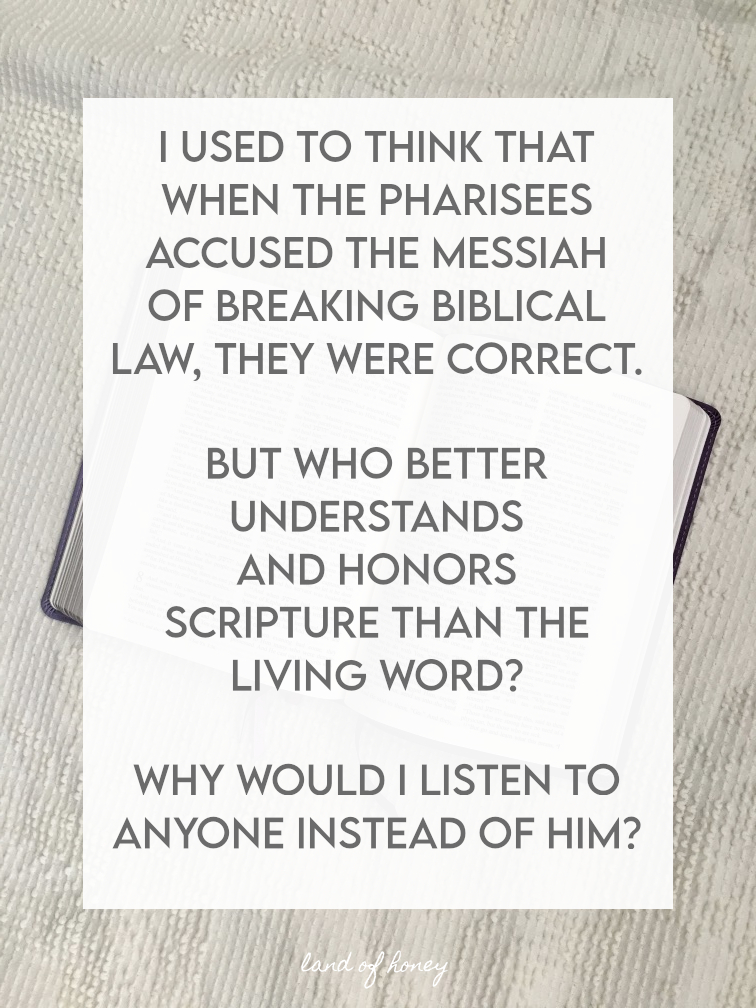
I used to read my Bible and think that when the Pharisees accused the Messiah of breaking Biblical law, they were correct. I figured that as the son of God, the Messiah had license to take some liberties. Just like the son or daughter of a business owner can, typically, get away with more slacking off than the average employee. And if keeping the law wasn't important to the Messiah, why on earth should it be to me?

One of the major themes of the New Testament that gets overlooked is the Messiah's harsh rebukes for manmade traditions. Many of us have made the assumption that the laws Yahusha stands against are from the Bible, buried deep somewhere in the Old Testament. But this is not the case. The laws he stood against were manmade, Jewish laws. It's important to know that Judaism has literally added thousands upon thousands of rules to their religious system that aren't found in Scripture. We see the Messiah's contempt for this in Mark 7:8, "You lay aside the commandments of YHWH, and instead hold to the traditions of men."

The Messiah frequently upset religious leaders. As did his followers. They frequently set aside manmade tradition or Jewish laws that weren't found in the Bible. But they didn't break the commandments of Scripture!

Who better understands and honors the word of God than the Living Word? The Messiah never broke Biblical law. | Land of Honey


Some examples...

-Messiah accused of breaking the Sabbath day by healing someone. -Matthew 12:10
In Matthew 12:12 Yahusha responds to his accusers. He says, "It is lawful to do good on the Sabbath." That was not a new idea. He's not bending the rules or saying that it is lawful just because he says so. He is correcting his accusers. He's saying the Bible teaches this is lawful. He was not re-writing the Torah or making an "anything goes" loophole policy. He is explaining to them what the Bible says. While the Pharisees might say it is against their own laws to heal on the Sabbath, the Bible does not say this. Of course this means the Messiah did not break the law with his Sabbath healings.

-Followers eating grain on the Sabbath. -Luke 6:1-5
I think the Messiah almost brags a little here.... It's the Sabbath and some of his disciples are hungry, so they picked some kernels of wheat in a nearby field and threshed them in their hands to take off the hard chaff. While the Bible says we aren't to work on the Sabbath it does not say that you can't peel an orange to eat (which would be somewhat similar to what the disciples were doing). Yahusha told the accusers he was the Master of the Sabbath, as in I'm the best at this and I know what's permissible or not. No one knows more about what's lawful on the Sabbath than I do.

-Accusation of eating with unwashed hands. -Mark 7
Scripture tells us that there are certain animals we are not to eat, and that we are not to eat blood, and that's about it. So, yes, there are dietary laws but the Bible doesn't say that we need to do a ritual hand washing before we eat, otherwise that food magically becomes unclean or defiling. The "tradition of the elders of ritual hand washing" is not a commandment of YHWH, it's a tradition of men, and the Messiah did not stand for it. See more about that in this post.

-Peter's vision of going to the Gentiles. -Acts 10
Throughout Scripture non native born Israelites have been welcomed into the family of YHWH...the Israelites left Egypt with a "mixed multitude" of Egyptians who wanted to serve YHWH after seeing his mighty acts. Women like Rahab and Ruth were not born Israelites but are celebrated in the Messiah's lineage. Caleb was not a native born, and the prophet Obadiah is believed to be from Edom. Not allowing people like this into the faith is unbiblical. This practice was prevalent in the early church, which is why YHWH gave Peter a vision and said, "What I call clean, you do not call unclean." After this the Gospel was preached to the Gentiles.

-Paul confronting Peter about not eating with Gentiles when Jews were present. -Galatians 2:11-15
Paul tells Peter here that he shouldn't be following rules that aren't from the Bible. When he says, "You have discarded the Jewish laws, why are you trying to make these Gentiles follow Jewish tradition?" he means exactly that...Jewish tradition, not Scriptural commandments. He is in no way permitting or encouraging new believers to not follow the Biblical commandments.

"They worship me in vain, teaching as doctrines the commandments of men." -Matthew 15:9
The Messiah's statement here should be a stern warning to us not to place any human ideas or manmade traditions higher than what Scripture actually says! This goes for family traditions, Jewish law, and common Christian beliefs. None of these things should be treated as doctrines and they should never be deferred to over the commandments of the Bible.

Throughout the New Testament we see the Messiah and the apostles correcting these manmade laws. If we are going to correctly understand Scripture it is absolutely essential to realize the differences between the manmade traditions of Jewish law, and the commandments of YHWH. When the Messiah and his followers clashed with leaders of the Jewish faith, it was never because they weren't keeping a Biblical commandment. Religious leaders were upset because the Messiah was against their laws.

The Messiah always upheld and kept YHWH's instructions in the Torah. When he was accused of violating Biblical commandments, his accusers were in the wrong having applied their own traditions and customs to how the Bible is understood. Let us be careful today to not do the same thing!

The Messiah never broke Biblical law and never taught others to. He confronted religious leaders for their false teachings. | Land of Honey


More on the law:
Traditions or Commandments - Understanding the New Testament
The Faith of the Bible
The Three Types of Law in Scripture

Upcoming Biblical Holiday Dates 2026

Here's When the Biblical Holidays Happen in 2026

This is when the Biblical holidays happen in 2026. If you're looking for this year's dates for Passover, Unleavened Bread, First Fru...